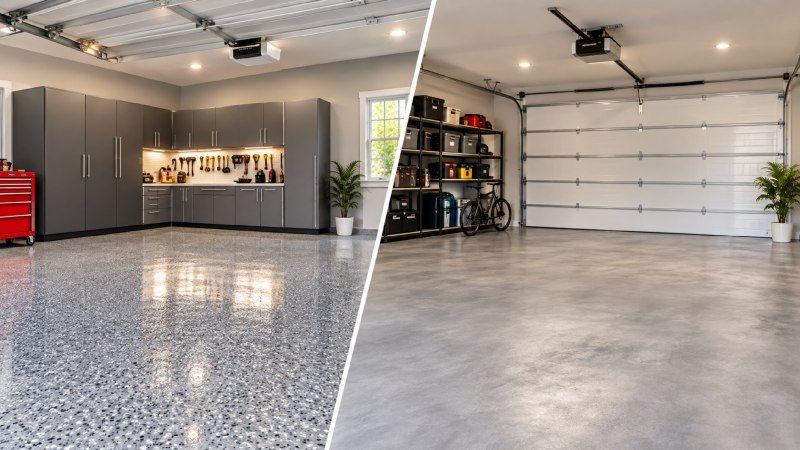
Microcement vs. Epoxy Garage Coatings: Which Flooring System Should You Choose?
Garage floors are exposed to a very different set of conditions than most residential interiors. Vehicles bring in water, dirt, road salt, oil, and other contaminants. The floor may also experience heavy traffic, impact, temperature changes, and frequent cleaning.
Epoxy coatings have long been associated with garage flooring because they provide a hard, protective surface. Microcement is a newer alternative that approaches the problem from a different perspective. Instead of creating a purely utilitarian coating, it combines a seamless architectural appearance with a durable surface system.
The right choice depends on whether the garage is primarily a working utility space, an extension of the living area, a showroom-style environment, or part of a broader architectural design.
What is the main difference?
Epoxy is a resin-based coating system designed primarily to create a hard, chemically resistant, durable surface. It is commonly associated with garages, workshops, industrial spaces, and utility areas.
Microcement is a thin cement-based decorative coating modified with resins and other components. Craftex describes its system as approximately 1 to 3 mm thick and suitable for floors, walls, furniture, and both indoor and outdoor applications.
The difference becomes especially noticeable in the visual character of the finished surface. Epoxy can create a highly uniform, glossy, or flake-based garage floor. Microcement creates a more architectural, hand-applied appearance with subtle variation in texture and color.
Which creates a more seamless appearance?
Both systems can create a surface without conventional tile grout lines, but they achieve that result differently.
Microcement is particularly suited to seamless design because it is trowel-applied across the substrate. Craftex offers more than 120 colors and textures, allowing designers to control the overall character of the surface.
Epoxy can also be continuous, but its appearance is typically more associated with industrial flooring. Decorative flakes, metallic effects, pigments, and gloss levels can change the appearance significantly.
For a garage that should visually connect with the rest of a contemporary home, microcement can therefore offer a more integrated architectural finish.
Which is better for heavy-duty garage use?
The answer depends on the specific use and system specification. Epoxy is a well-established choice for garages where chemical resistance and a hard-wearing floor are priorities.
Microcement can also provide a durable surface, and Craftex positions its system for high-traffic residential and commercial areas. The company states that its microcement is resistant to everyday wear, stains, and scratches when properly installed and sealed.
However, neither material should be selected solely based on marketing terminology. The substrate, preparation, thickness, sealer, expected traffic, and installation method all affect final performance.
What about maintenance?
Both surfaces can be relatively easy to clean compared with porous or heavily jointed flooring.
Microcement has the advantage of having no grout lines. Craftex recommends routine cleaning with suitable neutral-pH products and describes the finished system as low-maintenance.
Epoxy floors are also straightforward to clean because their continuous surface does not contain traditional grout joints. They are commonly selected for workshops and garages precisely because dirt and spills can be removed relatively easily.
For both systems, aggressive chemicals and unsuitable cleaning methods can damage the protective finish. Maintenance instructions should therefore come from the manufacturer and installer rather than being assumed from the appearance of the material.
Can microcement be used on garage walls as well?
This is one area where microcement offers considerable versatility. Craftex promotes the system for floors, walls, ceilings, countertops, furniture, stairs, fireplaces, and exterior surfaces.
That can be valuable in a high-end garage project. Instead of treating the floor as an isolated technical surface, the same material family can be extended to selected walls, built-ins, counters, or architectural details.
Epoxy systems can also be used beyond floors, but garage-specific epoxy applications tend to focus on protective coatings rather than creating a complete architectural language throughout the room.
What if the garage is connected to the house?
This is where the aesthetic difference can become especially important.
A detached workshop can prioritize performance and practicality. An attached garage, however, may form part of the visual experience of the house. If it contains custom cabinetry, a gym, a workshop, a vehicle collection, or a secondary living area, the floor may need to look more sophisticated than a conventional utility coating.
Microcement can bridge that gap. Its concrete-inspired appearance and broad range of colors allow the garage to feel like a deliberately designed part of the property rather than an isolated technical room.
Craftex offers both residential and commercial microcement applications, which makes the system adaptable to projects where design is as important as surface performance.
How does installation differ?
Epoxy installation generally involves careful substrate preparation followed by application of the resin-based coating system. The exact process varies according to the product and intended use.
Craftex describes a multi-stage microcement process involving preparation, priming, base coats, finishing layers, sanding, and sealing. Floors may also receive additional reinforcement as part of the system.
This highlights an important point: microcement is not simply a material that can be rolled onto any floor. Surface preparation and application technique are critical.
For that reason, professional installation is recommended, particularly in demanding environments such as garages.
Which is better for a design-focused garage?
Microcement is particularly compelling when the garage is being treated as part of the home’s architecture. The range of colors and textures allows the surface to be coordinated with cabinetry, walls, stone, wood, metal, or other materials.
Craftex’s Eco Cement collection provides concrete-inspired finishes, while its Metallic collection offers effects inspired by materials such as iron, bronze, copper, aluminum, and brass.
Epoxy remains an excellent option when the goal is a highly functional garage floor and the visual character of a resin coating is desirable.
Microcement or epoxy?
For a purely utilitarian garage where maximum focus is placed on a hard-wearing floor and established garage-coating technology, epoxy can be a logical choice.
For a contemporary garage where the flooring should contribute to the architecture, microcement offers more visual flexibility and can extend beyond the floor to create continuity across different surfaces.
Craftex is particularly relevant for this type of project because its microcement system combines a thin application, extensive color and texture options, indoor and outdoor versatility, and a portfolio covering residential and commercial applications.
The best material therefore depends on what the garage is expected to be. If it is primarily a workshop, performance may dominate the decision. If it is an extension of the home, showroom, gym, or architectural space, the design advantages of microcement may become much more significant.