How to Verify a Bedroom Furniture Supplier Before You Buy
Choosing bedroom furniture is one of the more considered purchases most homeowners make. Unlike decorative accessories that can be swapped out easily, a bed frame, wardrobe, or dresser tends to stay in place for years. Getting the furniture right means getting the supplier right first, and that part of the process is something buyers often underestimate.
Whether you are buying from a local retailer or working directly with a manufacturer, the supplier’s production quality and reliability will shape everything from the materials used to the consistency of the finish you receive. For buyers exploring factory-direct options, working with a reputable Indonesian furniture supplier has become a practical route to accessing solid wood bedroom furniture at a price point that domestic retail rarely matches, without sacrificing quality when you know what to look for.
This guide walks through the key things to verify before committing to any bedroom furniture purchase.
Why Supplier Verification Matters More Than Most Buyers Realize
Most buyers focus on product photography and price. Both matter, but neither tells you much about what will actually arrive at your door.
The gap between how furniture looks in a product image and how it performs in a real bedroom comes down almost entirely to the manufacturing process behind it. A supplier who uses properly dried timber, consistent finishing systems, and sound joinery construction will produce a piece that looks good and holds up over years of use. A supplier cutting corners in any of those areas will produce something that looks passable in photos but shows its weaknesses within months.
For bedroom furniture specifically, where pieces are expected to stay put for a decade or more, this distinction matters more than in rooms where furniture turns over more frequently.
What to Check Before Placing an Order
1. Confirm Whether the Supplier Is a Manufacturer or a Trader
This is the first and most important question. Many suppliers who present themselves as manufacturers are actually trading companies that source from multiple workshops and resell under their own name. There is nothing inherently wrong with that model, but it means the supplier has less control over quality at the production level.
A genuine manufacturer controls the full production process in-house: timber intake, kiln-drying, machining, assembly, sanding, finishing, and packaging. When you ask about the production process and get specific, detailed answers, that is a good sign. Vague answers or redirections to a catalog are a signal to probe further.
Ask directly: “Is this produced in your own facility?” and “Can you describe your production workflow from raw material to finished product?”
2. Ask About the Kiln-Drying Process
Kiln-drying is the step that most buyers never think to ask about, and it is one of the most consequential decisions in furniture manufacturing.
Wood that has not been properly dried to the right moisture content before being used in production will move after the piece is assembled. In a bedroom environment, that means warping, joint gaps, and drawer misalignment developing over time regardless of how solid the construction looks when the piece first arrives.
Proper kiln-drying brings the timber’s moisture content down to a stable level suited to the climate where the furniture will be used. A supplier operating at a professional level will be able to tell you their target moisture content and how long their kiln-drying process takes. If the answer is uncertain, that is a meaningful data point.
3. Review the Joinery Construction
How furniture is put together determines how it holds up under daily use. For bedroom furniture, the stress points are at the frame joints on beds (where the side rails meet the headboard and footboard), at drawer connections on dressers and wardrobes, and at leg joints on bedside tables and benches.
Traditional joinery methods like mortise-and-tenon create mechanical bonds that hold under repeated stress. Cam locks and dowel-only construction are faster to produce but less durable over time.
Ask the supplier what joinery method is used on the specific pieces you are considering. If they cannot answer with specifics, it is worth requesting a sample or finding a supplier who can.
4. Verify the Finishing System
The finish on bedroom furniture serves two purposes: protection and appearance. For indoor pieces, the finishing system needs to be durable enough to handle daily contact (elbows on a dresser surface, hands on drawer fronts, objects placed repeatedly in the same spots) and stable enough to resist fading or yellowing near windows.
When evaluating a supplier, ask what finishing system the team uses and how many stages the process involves. Multi-stage finishing, where the team sands, seals, sands again, and finishes the piece in controlled indoor conditions, produces more consistent and durable results than a single-coat application.
Request photos of finished pieces in natural light, not just studio photography. The quality of a finish shows differently depending on lighting conditions.
5. Request Information on Batch Consistency
If you are ordering more than one piece, or a set of matching items like a bed frame and two bedside tables, batch consistency becomes important. The pieces need to match each other in color tone, surface sheen, and grain character.
This is an area where manufacturers with tightly controlled in-house production have a clear advantage over suppliers sourcing from multiple workshops. Ask whether the pieces in your order will be produced in the same production batch, and whether the supplier has a system for color and finish matching across items.
6. Check Export and Documentation Capability
If you are sourcing from an overseas manufacturer, the supplier’s experience with export documentation will affect your delivery experience. Import requirements vary by country but typically include phytosanitary certificates (for solid wood), correct material declarations, and appropriate packaging to prevent transit damage.
An experienced exporter handles this as a routine part of every order. A less experienced one may create delays or require you to manage documentation gaps yourself. Ask whether they have shipped to your country before and what documentation they provide as standard.
A Note on Sourcing Indonesian Bedroom Furniture
Indonesia is one of the world’s most established sources of solid wood furniture, with manufacturing centers in Java that have decades of export experience. The range of materials available, including teak, mahogany, sungkai, and mindi, covers a wide spectrum of budgets and aesthetics.
For bedroom applications, Indonesian bedroom furniture made from mahogany or sungkai is particularly well-suited. Both materials are dimensionally stable in indoor conditions, accept finishing with high consistency, and are available in styles ranging from classic to contemporary. Teak is an option too, though its primary advantage is weather resistance, which matters more in outdoor applications than in a controlled bedroom environment.
The key, as with any sourcing decision, is identifying a manufacturer who operates with in-house production controls rather than sourcing from multiple suppliers. The verification steps above apply equally whether you are buying from an Indonesian factory or a domestic retailer.
Red Flags to Watch For
A few warning signs are worth keeping in mind as you evaluate suppliers:
Unwillingness to answer specific production questions. A supplier who cannot or will not describe their manufacturing process in specific terms is probably not producing in-house.
No sample option available. Reputable manufacturers accommodate sample requests for serious buyers. Resistance to samples before large orders is a signal worth taking seriously.
Very short lead times on custom orders. Quality bedroom furniture production, especially for custom specifications, takes time. Lead times that seem too short often indicate corners being cut somewhere in the process.
Inconsistent photography. If product images across the same collection show noticeable variation in color tone or finish quality, that variation likely exists in the physical product too.
Generic answers to specific questions. If a supplier answers your questions about joinery, drying, or finishing with broad marketing language instead of specific process details, keep asking questions or look elsewhere.
Final Thoughts
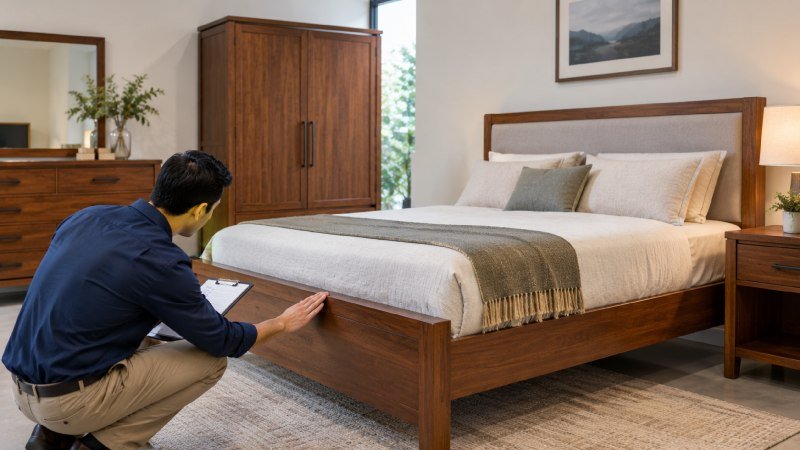
Verifying a bedroom furniture supplier before buying isn’t complicated, but it does require asking the right questions and understanding what the answers mean.The manufacturers who produce furniture worth owning are almost always willing to be specific about their process, because their process is what sets them apart.
Taking an hour to properly evaluate a supplier before placing an order can save you from a purchase that looks right in the catalog but disappoints in the bedroom. The questions in this guide are a practical starting point for any buyer who wants to move beyond product photography and make an informed decision.