How to Choose Bathroom Tiles in Melbourne for a Stylish and Practical Space
Bathrooms are wet every single day. That really takes its toll on a floor. A poor tile choice might cause you to slip, trap mold – or look tired after just two years. Want to browse bathroom tiles melbourne shoppers can choose from? Do that first. Then check out three things before purchasing. Just how slippery is the tile when it’s wet? Will it absorb a lot of water? And how many grout lines will there be? Grout is that rather soft material between tiles – and dirt and mildew just adore living in it. This blog explains each check in plain words, with real numbers from Australian standards.
Why does slip rating matter more than looks?
Australia’s slip resistance is tested by dragging a swinging rubber foot over a wet tile. The test – known as AS 4586 – then rates each tile from P0 to P5. P0 is slippery as soap. P5 is grippy as a rock. A P3 tile will score 35-44 on the test, a P4 scores 45-54, while a P5 scores more than 54. Most suppliers say bathroom floors should be P3 or higher. Wall tiles do not need a slip rating at all. Nobody walks on a wall.
Is porcelain really worth the extra money?
On floors, yes. Porcelain is baked at about 1,200 to 1,300 degrees Celsius until it turns super dense. Under the ISO 13006 rules, a tile only counts as porcelain if it soaks up 0.5% water or less. Here is how the usual choices compare.
| Tile type | Water it soaks up | Where to use it |
|---|---|---|
| Porcelain | 0.5% or less | Floors, showers, walls |
| Standard ceramic | More than 0.5% | Walls and splashbacks |
| Natural stone | Varies, needs sealing | Dry feature walls |
Should you use big tiles or small ones?
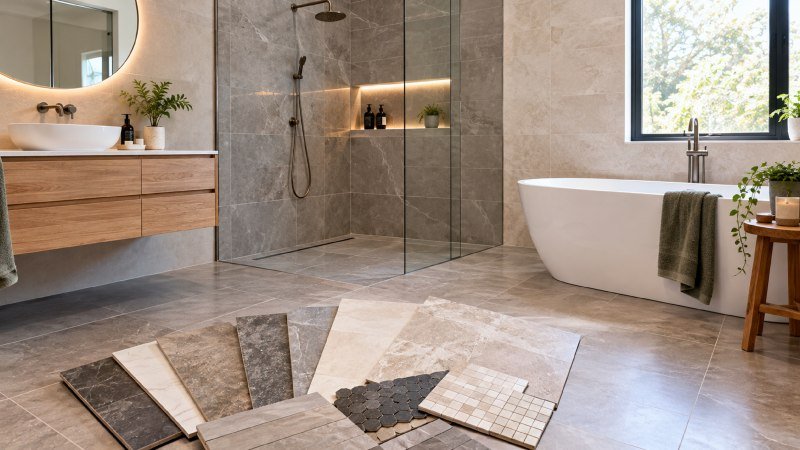
Big on the walls, small on the shower floor. That rule works. Big tiles really do mean fewer grout lines – and it’s grout that lets water and mould seep in. Rectified tiles are precisely cut, so their grout lines can be just 2 millimetres wide. However, the waterproofing standard AS 3740 requires wet floors to slope towards the drain – whilst a very large flat tile simply won’t bend. Small mosaic tiles easily follow the slope. They are more expensive to install, so consider using them for the shower floor only – and try not to make too much work out of it. A 2026 Melbourne cost guide notes that wall tiling labor costs approximately $42 to $105 per square metre.
What should you check before the tiler starts?
Waterproofing is number one – and it’s no weekend project. Here in Victoria you need a licensed waterproofing professional doing it – and all work must adhere to AS 3740 standards. The membrane sits right underneath your tiles, which means an attractive tile won’t make up for a leaking sub-base. So then, go through this checklist.
- Wet a sample at home and drag a bare foot across it. The box says P3, but your feet make the final call.
- Pick matte for floors. Shiny, polished tiles are usually the slippery ones.
- Match the grout to the tile colour. Dirt and thin lines hide better that way.
- Check the batch number on every box, because different batches can come in slightly different shades.
- Ask your tiler how the floor will slope to the drain before the glue comes out.