GLM 5.3 Abliterated API: Three Dollars With No Evidence
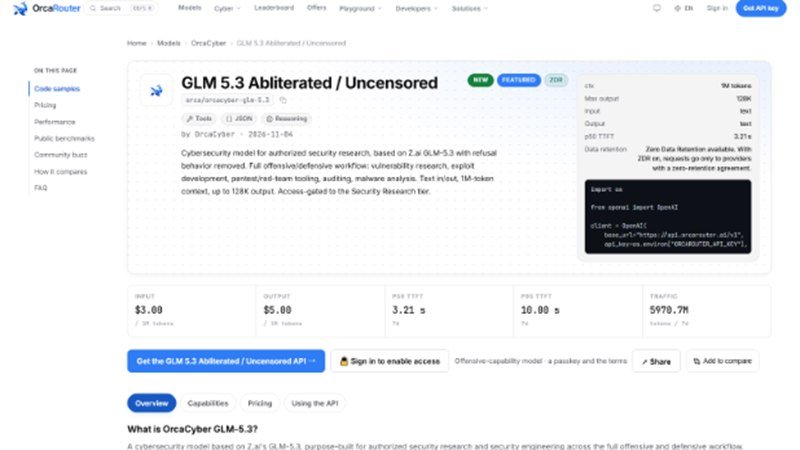
At $3.00 in and $5.00 out, OrcaRouter‘s GLM 5.3 abliterated API is the second most expensive card in the cyber tier and publishes no benchmark rows whatsoever. `benchmarks: []`. Not a suppressed block, not a section that failed to load — the payload carries an empty array, and the page renders an empty section. The only card above it on price is Kimi at `$4.00 / $20.00`, and Kimi’s block is empty too.
Which makes a specific procurement question unavoidable: at three dollars per million input tokens, what are you buying and on what evidence? The card answers the first half precisely — a 1,000,000-token context, a 128,000-token output ceiling, 87.7 output tokens per second, eleven supported parameters, one endpoint, a 10.00% cache fraction — and does not attempt the second.
The two cards above $0.80, side by side
| GLM 5.3 | Kimi K3.1 Pro | |
| input / output | $3.00 / $5.00 | $4.00 / $20.00 |
| cached input | $0.300 (10.00%) | $0.350 (8.75%) |
| context | 1,000,000 | 1,048,576 |
| max output | 128,000 | 943,718 |
| output ÷ context | 0.128 | 0.900 |
| throughput | 87.7 tok/s | 71.7 tok/s |
| p50 | 3,206 ms | 1,749 ms |
| error rate | 15.49% | 1.09% |
| endpoints | 1 | 1 |
| parameters | 11 | 11 |
| benchmark rows | 0 | 0 |
| quality score | 9 | 9 |
Two cards, identical on five rows, wildly different on four. And both carry a quality score of 9 with nothing published behind it.
The pair is the clearest illustration in the tier that price and quality score are not descriptions of the same thing. The card at `$3.00` and the card at `$4.00 / $20.00` are both rated 9. Whatever the score encodes, it does not distinguish between a card whose worst case is `$0.640` per answer and one whose worst case is `$18.874`.
What three dollars actually buys
Strip the score and the empty block and the card is left with a small set of concrete properties, and they do add up to something defensible.
A million-token context at the second-lowest input rate among the non-flash cards. If you need to send a large repository and you do not want to pay `$4.00` for the privilege, this card is the option. The `$1.00` difference per million against Kimi is `$0.20` on a 200,000-token context — small in absolute terms, and it compounds across a fleet.
A 128,000-token output ceiling. Not the widest, and 7.3× Kimi’s rate would be absurd at that ceiling, so the shape is coherent: this is a card built to read a lot and write a moderate amount, priced for the reading.
A 10.00% cache fraction with a `$2.70` absolute saving. The largest saving after Kimi’s `$3.65`. On a card at this rate, cache behaviour decides the bill more than the rate does.
87.7 tokens per second at a 3,206 ms median. Mid-table on both, and the combination means a long answer takes real wall-clock time: 2,000 tokens is 23 seconds of streaming.
Against that, one deterrent that is not a benchmark: 15.49% errors. Fourteen times the tier’s band. Any of the three virtues above is worth less if a seventh of your traffic fails.
Why an empty benchmark block is different on a card at this price
On a `$0.80` card, an empty benchmark block is a modest problem: the downside is bounded at `$0.64` a maximal answer and the integration is a morning’s work.
On a card at `$3.00 / $5.00`, the same gap costs more in every dimension. A maximal answer is `128,000 × $5.00 / 1M = $0.640`; a 200,000-token context is `$0.60` of input per call; a pilot that runs a thousand requests costs real money before you learn anything. The evidence you would normally weigh — a SWE-bench row, a CyberGym row, a CTF score — is exactly the evidence that would let you size the pilot correctly, and it is absent.
So the decision this card poses is not “is it good” but “how much does it cost to find out”. The honest answer is: one pilot, scoped to twenty tasks you have already solved, with a budget cap. On this card a twenty-task pilot with 200,000-token contexts is under `$15` of input. That is cheaper than the meeting where you would argue about it.
What the lineage tells you to go and read
The card’s copy names its base: Z.ai GLM-5.3, with refusal behaviour removed. That is the only lineage statement on the page and it is more useful than a benchmark block would be, because it points at a body of published evaluation you can go and check.
The base model has public evaluations. They describe the checkpoint before the refusal behaviour was removed. That is the same limitation every benchmark row on every card in this tier has — all of them were run weeks before their cards shipped — but on this card it is the *only* evidence available, so it carries the whole weight.
What the lineage does not tell you: how the removal affected the model’s behaviour on tasks the benchmark measured. Nobody in this tier published a post-removal run. The three cards that publish rows ran them on base checkpoints; the three that publish nothing ran nothing. Either way, the numbers you can find describe an ancestor.
A note on the 15.49% that is worth separating out
This card’s error rate is covered in detail elsewhere in this set, and one thing from that analysis belongs here because it affects the procurement arithmetic.
GLM 5.3 exposes eleven parameters and one endpoint. The same eleven as Kimi and as Hy4, both of which run at 1.09% and 0.255%. So the narrow surface alone does not produce a 15.49% error rate; something about this card’s onboarding or its callers does.
Which matters for a buyer weighing the pilot: the error rate is an argument for instrumenting, not an argument against the card. Instrument first, separate timeouts from validation failures in your own logs, and the number either falls into the tier’s band or tells you something specific about the request shape you are sending.
The takeaway
GLM 5.3 abliterated costs `$3.00 / $5.00`, publishes zero benchmark rows, and carries a quality score of 9 that has nothing behind it. It buys a million-token context at the second-lowest rate in the tier, a 128,000-token ceiling, and a `$2.70` cache saving — and it comes with a 15.49% error rate that has to be instrumented before it is trusted.
Pilot it against twenty tasks you already know the answer to. On this card that costs less than the argument about whether to pilot it.