Best Spray Tips for Elastomeric Coatings: A Practical Guide for Contractors
Spray tip selection is one of the most underestimated variables in elastomeric coating application. Contractors who have been applying standard exterior latex for years sometimes approach elastomeric jobs with the same tip selection logic — and then spend the day fighting poor atomization, tip clogging, inadequate film build, or all three simultaneously.
Elastomeric coatings are a different category of material. They are engineered to build significant film thickness, seal substrates, and flex with the structure they’re applied to. That performance comes from a high-solids, high-viscosity formulation that behaves differently through an airless tip than standard coating materials. Applying them correctly starts with the right tip specification.
Understanding Tip Nomenclature
Every airless spray tip is identified by a three or four digit number that encodes two specifications: fan width and orifice size. Both matter for elastomeric work, and understanding them is prerequisite to making an informed tip selection.
Fan Width
The first one or two digits in the tip number represent half the fan width produced at 12 inches from the surface. A tip with a first digit of 5 produces a 10-inch fan at 12 inches. A tip with a first digit of 6 produces a 12-inch fan at 12 inches.
Fan width affects coverage rate, overspray control, and the practical application distance. On large flat masonry surfaces with no obstruction, a wider fan increases production rate. Near windows, doors, and trim lines, a narrower fan gives better control and reduces the masking and cleanup cost of overspray.
Orifice Size
The last two digits are the orifice diameter in thousandths of an inch. A 515 tip has a 0.015-inch orifice. A 527 tip has a 0.027-inch orifice. The orifice controls how much material flows through the tip per unit time at a given pressure, and it must be sized to match both the material’s viscosity and the machine’s output capacity.
For standard exterior latex at typical residential painting viscosities, orifice sizes in the 0.015 to 0.019 inch range are standard. For elastomeric coatings, the orifice needs to be larger — the material is thicker, and a tip that’s too small either clogs immediately or requires excessive pressure to force the material through, degrading atomization quality and accelerating tip wear.
Orifice Size Recommendations for Elastomeric Coatings
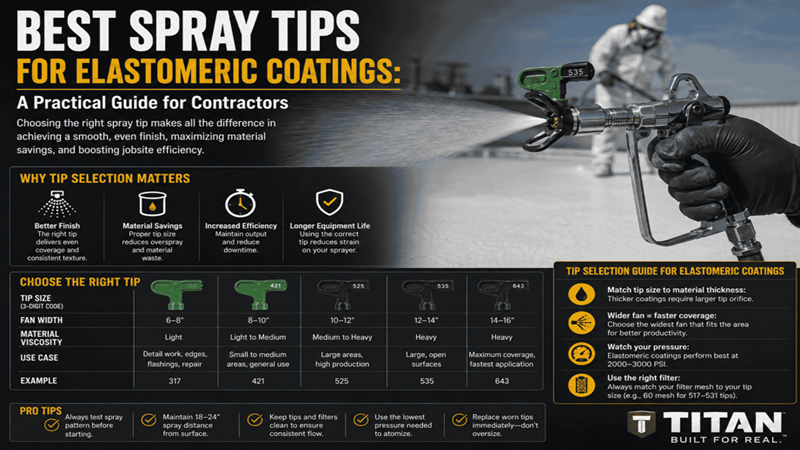
The general operating range for elastomeric coatings is 0.021 to 0.031 inch orifice. Within that range, the appropriate size depends on the specific product and application requirements.
Start with the manufacturer’s technical data sheet. Every major elastomeric coating manufacturer publishes application guidelines that include recommended tip size ranges for their product. This is your most reliable starting point — the manufacturer has tested their product specifically and knows what tip size produces the specified film build at the specified pressure.
Lighter elastomeric products (smooth surfaces, lower build requirements): 0.021 to 0.025 inch. Products in the 50–60% solids range applied to smooth CMU or precast concrete often work well with a 521 or 525. Flow is adequate, atomization is controlled, and overspray is manageable.
Standard elastomeric wall coatings (textured masonry, stucco, mid-range film build): 0.025 to 0.027 inch. The 525 and 527 are the most commonly used tips for standard elastomeric work on textured substrates. The 527 is often preferred on medium to coarse texture where material needs to penetrate into the texture valleys rather than bridge across them.
High-build elastomerics and roof coatings (high solids, heavy film build requirements): 0.027 to 0.031 inch. Products designed for roof coating applications or for meeting specific mil thickness specifications often need a 529 or 531 to achieve required coverage in a practical number of passes. Running a 527 on a 70%-solids roof coating typically means more passes than the job schedule allows.
The Titan spray tips catalog at AllTitanParts.com carries HEA and standard reversible tips in every common orifice size and fan width, including the larger orifice sizes used for elastomeric and roof coating applications.
Pressure Settings for Elastomeric Work
Proper atomization of elastomeric materials requires higher operating pressures than standard latex applications. Standard exterior latex typically atomizes well at 1,800 to 2,200 PSI. Elastomeric coatings generally need 2,400 to 3,000 PSI for adequate atomization, with the specific pressure depending on the product viscosity and the tip size in use.
The field test for correct pressure:
Hold the gun at 12 to 14 inches from a test surface — cardboard or a test panel — and trigger a short burst. Examine the spray pattern carefully.
Heavy tails — bands of thick, coarse material at the edges of the fan with thinner coverage in the center — indicate insufficient pressure. The tip is not receiving enough pressure to atomize the material evenly across the full fan width. Increase pressure in 200 PSI increments and re-test until the tails disappear.
Coarse center atomization with fine edges — large, poorly atomized droplets in the center of the fan with better atomization at the edges — typically indicates an orifice that is too large for the pressure available. The tip is flowing more material than the available pressure can atomize cleanly. Try stepping down one tip size.
Even distribution with no tails and consistent droplet size across the full fan width — this is correct atomization. Record the pressure setting and use it as your reference for that product and tip combination.
Do not compensate for an incorrect tip size by running extreme pressures. Excessive pressure causes rapid tip wear, particularly with the high-solids materials used in elastomeric applications. It also increases overspray significantly.
Machine Compatibility for Elastomeric Work
Not every airless sprayer can handle elastomeric coatings at production rates, and matching the machine to the tip and material is part of getting the application right.
Tip size limits: Every airless sprayer has a maximum rated tip size — usually expressed as the maximum orifice diameter the machine can drive at rated pressure without exceeding the motor’s rated output. Running a 529 or 531 tip on a machine rated for a maximum 0.021 inch orifice will strain the motor and reduce operating pressure below the threshold needed for proper atomization.
Flow capacity: The machine must deliver adequate flow volume at the required pressure. Flow capacity is expressed in gallons per minute at rated pressure. A machine rated at 0.47 GPM may not provide adequate flow for production-rate roof coating with a 0.031 inch tip.
For high-volume elastomeric and roof coating applications where production rate is a priority, air powered airless sprayer equipment designed for industrial duty — the Titan PowrCoat series, Speeflo Commander — provides the flow capacity and continuous duty cycle that large-scale elastomeric applications require.
Tip Wear in Elastomeric Applications
Elastomeric coatings wear tips faster than standard latex. The combination of high solids content, higher operating pressures, and the abrasive nature of some formulations (particularly those containing aggregate fillers) accelerates carbide orifice wear compared to standard residential painting applications.
Monitor tip condition throughout an elastomeric job by periodically checking the spray pattern against the pattern you established at setup. When you see the fan width widening, the pattern becoming inconsistent, or pressure requirements increasing to maintain the same pattern quality, the tip is wearing.
A common rule of thumb: a tip has reached the end of its useful life when the orifice has worn 50% larger than its original specification. A 0.021-inch tip worn to 0.032 inch is no longer performing within its design parameters. Replace it and don’t attempt to compensate with additional pressure — a worn tip at higher pressure wears faster, atomizes worse, and puts unnecessary strain on the pump.
Keep spare tips on the job for elastomeric work. Running out of serviceable tips mid-job on a large commercial application is an avoidable problem.
HEA Tips for Elastomeric Applications
Titan’s HEA (High Efficiency Airless) tip technology produces finer atomization at lower operating pressures than conventional tip geometry, with the primary benefit of significantly reduced overspray — up to 55% less than conventional airless tips according to Titan’s own data.
For elastomeric applications, HEA tips are particularly useful on jobs where overspray control matters — near occupied spaces, adjacent to finished surfaces, or where masking and cleanup costs are significant. The lower operating pressure also reduces wear on the pump and tips relative to conventional tips at full pressure.
On very coarse textured surfaces where material needs to penetrate deep into the texture profile rather than bridge across it, some applicators find that conventional tips at slightly higher pressure achieve better texture penetration. This is a judgment call based on the specific substrate texture and the coating product’s flow characteristics.
In most commercial and residential elastomeric applications, airless sprayer parts that keep your machine running at the correct pressure range — functional pump components, proper filter maintenance — have more impact on application quality than the choice between HEA and conventional tips within the same orifice specification.
Practical Tip Selection Summary
Starting point: always check the product manufacturer’s TDS for their recommended tip size range before selecting a tip.
Working range by application type:
- Standard elastomeric on smooth to medium texture: 525 or 527
- High-build elastomeric on coarse texture: 527 or 529
- Roof coating / extreme high-build: 529 or 531
- Smaller areas, detail work, perimeters: reduce fan width (first digit) while keeping the same orifice
Have spare tips on the job. Monitor tip condition through the pattern rather than the hour count. Replace tips at the first sign of fan degradation rather than at failure.
The right tip, correctly matched to the material and the machine, is the most cost-effective quality control step in any elastomeric application.
Nnanna Otuonye is the founder of AllTitanParts.com, an authorized OEM dealer of Titan, SprayTech, Wagner, and Speeflo airless sprayer parts located at 5250 Gulfton St, Suite 1H, Houston, Texas 77081. With over 20 years in the spray equipment industry, he supplies painting contractors and industrial coating professionals across the United States with genuine factory parts and same-day shipping.